Learning Outcomes:
i. Define meristems and explain their significance in plant growth and development.
ii. Differentiate between apical meristems and lateral meristems, describing their location and function.
iii. Describe the role of apical meristems in primary growth, including the formation of roots, stems, and leaves.
iv. Explain the contribution of lateral meristems to secondary growth, resulting in the increase in girth of stems and roots.
v. Analyze the impact of environmental factors on meristem activity and plant growth.
i. Meristems: The Plant's Growth Engine
Meristems are specialized regions of actively dividing cells that are responsible for plant growth and development. These dynamic tissues possess the unique ability to continuously produce new cells, providing the building blocks for the formation of new organs and tissues. Meristems are found in various parts of the plant body and play crucial roles in both primary and secondary growth.
ii. Apical Meristems: Guiding the Way
Apical meristems are located at the tips of roots and shoots, directing the elongation of these plant organs. They consist of undifferentiated cells that undergo rapid cell division, providing a continuous source of new cells for growth.
Root apical meristem: The root apical meristem is responsible for the downward growth of the root system, enabling the plant to anchor itself in the soil, absorb water and nutrients, and explore new areas for resource acquisition.
Shoot apical meristem: The shoot apical meristem is responsible for the upward growth of the stem and the formation of leaves, flowers, and other organs. The continuous division of cells in the shoot apical meristem leads to the complex branching patterns of plants.
iii. Lateral Meristems: Adding Girth
Lateral meristems are located parallel to the longitudinal axis of the plant, contributing to the increase in girth or diameter of stems and roots. They consist of undifferentiated cells that undergo cell division, producing new cells that differentiate into specialized tissues.
Vascular cambium: The vascular cambium is responsible for the formation of secondary xylem and secondary phloem. Secondary xylem, also known as wood, provides additional support and contributes to the transport of water and minerals. Secondary phloem, also known as bast, transports nutrients and organic compounds throughout the plant.
Cork cambium: The cork cambium is responsible for the formation of cork, a protective layer that replaces the epidermis as the stem or root grows in diameter. Cork cells are dead cells with suberized cell walls, providing protection against water loss, mechanical damage, and environmental stresses.
iv. Environmental Influences on Meristem Activity
Meristem activity, and consequently plant growth, is influenced by various environmental factors:
Light: Light plays a crucial role in regulating the activity of apical meristems, particularly in shoot growth. Adequate light promotes cell division and elongation, leading to normal stem and leaf development.
Temperature: Optimal temperatures are essential for meristem activity and plant growth. Extreme temperatures, whether too high or too low, can disrupt cell division and differentiation, affecting plant growth and development.
Water availability: Water is a critical component of plant cells and is essential for cell division and elongation. Adequate water availability supports meristem activity and overall plant growth.
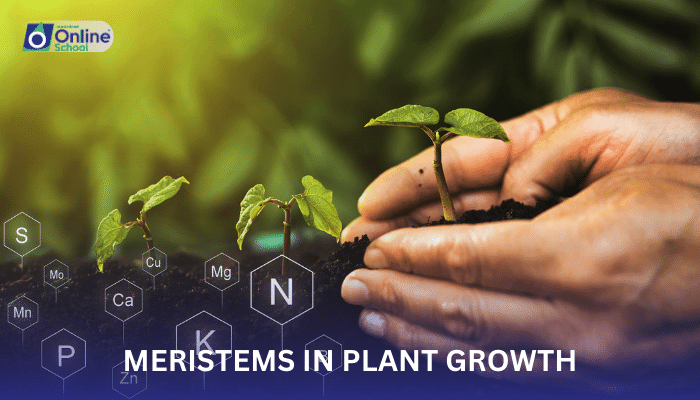
Nutrient availability: Nutrients, such as nitrogen, phosphorus, and potassium, are essential for various plant processes, including cell division and differentiation. Adequate nutrient availability is crucial for normal meristem function and optimal plant growth.
Meristems, both apical and lateral, are the driving force behind plant growth and development. Their ability to continuously produce new cells allows plants to expand their root systems, develop complex branching patterns, and form specialized tissues and organs. Understanding the location, function, and environmental factors that influence meristem activity provides valuable insights into plant physiology, ecology, and agriculture.
